| |
JOINT DESIGN AND PREPARATION OF METALS |
| Welding Data >> JOINT DESIGN AND PREPARATION OF METALS |
|
JOINT DESIGN AND PREPARATION OF METALS
4-1. JOINT TYPES
Welds are made at the junction of the various pieces that make up the weldment. The junctions of parts, or joints, are defined as the location where two or more nembers are to be joined. Parts being joined to produce the weldment may be in the form of rolled plate, sheet, shapes, pipes, castings, forgings, or billets. The five basic types of welding joints are listed below.
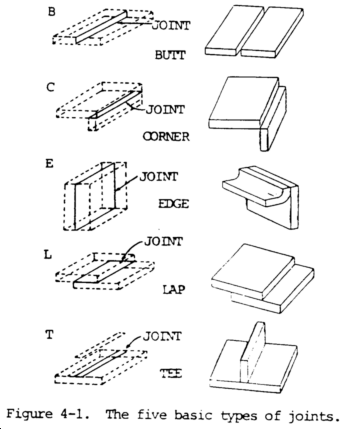
a. B, Butt Joint. A joint between two members lying approximately in the same plane.
b. C, Corner Joint. A joint between two members located approximately at right angles to each other in the form of an angle.
c. E, Edge Joint. A joint between the edges of two or more parallel or mainly parallel members.
d. L, Lap Joint. A joint between two overlapping members.
e. T, Tee Joint. A joint between two members located approximately at right angles to each other in the form of a T.
4-2. WELD JOINTS
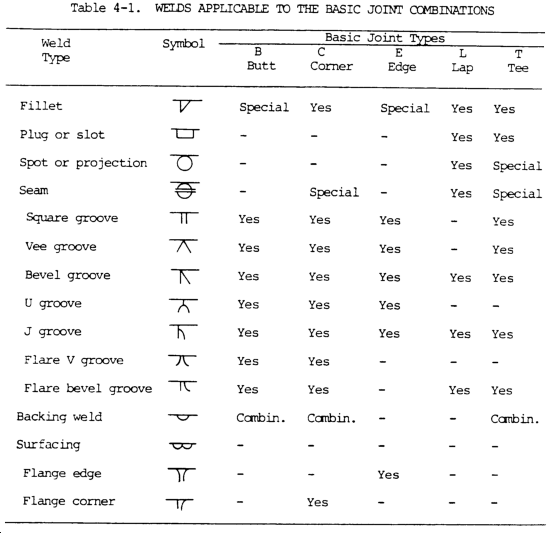
In order to produce weldments , it is necessary to combine the joint types with weld types to produce weld joints for joining the separate members. Each weld type cannot always be combined with each joint type to make a weld joint. Table 4-1 shows the welds applicable to the basic joints.
4-3. WELD JOINT DESIGN AND PREPARATION
a. Purpose. Weld joints are designed to transfer the stresses between the members of the joint and throughout the weldment. Forces and loads are introduced at different points and are transmitted to different areas throughout the weldment. The type of loading and service of the weldment have a great bearing on the joint design required.
b. Categories. All weld joints can be classified into two basic categories: full penetration joints and partial penetration joints.
(1) A full penetration joint has weld metal throughout the entire cross section of the weld joint.
(2) A partial penetration joint has an unfused area and the weld does not completely penetrate the joint. The rating of the joint is based on the percentage of weld metal depth to the total joint; i. e., a 50 percent partial penetration joint would have weld metal halfway through the joint.
NOTE
When joints are subjected to dynamic loading, reversing loads, and impact leads, the weld joint must be very efficient. This is more important if the weldment is sub jetted to cold-temperature service. Such services require full-penetration welds. Designs that increase stresses by the use of partial-penetration joints are not acceptable for this type of service.
c. Strength. The strength of weld joints depends not only on the size of the weld, but also on the strength of the weld metal.
(1) Mild and low alloy steels are generally stronger than the materials being joined.
(2) When welding high-alloy or heat-treated materials, special precautions must be taken to ensure the welding heat does not cancel the heat treatment of the base metal, causing it to revert to its lower strength adjacent to the weld.
d. Design. The weld joint must be designed so that its cross-sectional area is the minimum possible. The cross-sectional area is a measurement of the amount or weight of weld metal that must be used to make the joint. Joints may be prepared by shearing, thermal cutting, or machining.
(1) Carbon and low alloy joint design and preparation. These weld joints are prepared either by flame cutting or mechanically by machining or grinding, depending on the joint details. Before welding, the joint surfaces must be cleared of all foreign materials such as paint, dirt, scale, or must. Suitable solvents or light grinding can be used for cleaning. The joint surface should not be nicked or gouged since nicks and gouges may interfere with the welding operation.
CAUTION
Aluminum and aluminum alloys should not be cleaned with caustic soda or strong cleaner with a pH above 10. The aluminum or aluminum alloy will react chemically with these types of cleaners. Other nonferrous metals and alloys should be investigated prior to using these cleaners to determine their reactivity.
(2) Aluminum and aluminum alloy joint design and preparation. Weld joint designs often unintentionally require welds that cannot be made. Check your design to avoid these and similar errors. Before welding, the joint surfaces must be cleared of all foreign materials such as paint, dirt, scale, or oxide; solvent cleaning, light grinding, or etching can be used. The joint surfaces should not be nicked or gouged since nicks and gouges may interfere with welding operations.
(3) Stainless steel alloy joint design and preparation. These weld joints are prepared either by plasma arc cutting or by machining or grinding, depending on the alloy. Before welding, the joint surfaces must be cleaned of all foreign material, such as paint, dirt, scale, or oxides. Cleaning may be done with suitable solvents (e. g., acetone or alcohol) or light grinding. Care should be taken to avoid nicking or gouging the joint surface since such flaws can interfere with the welding operation.
4-4. WELD ACCESSIBILITY
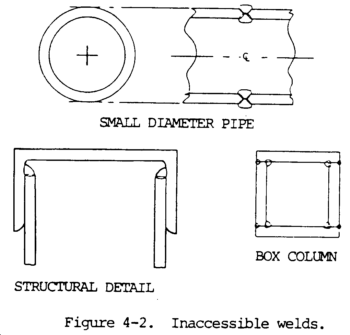
The weld joint must be accessible to the welder using the process that is employed. Weld joints are often designed for welds that cannot be made. Figure 4-2 illustrates several types of inaccessible welds.
Authorization Letter
|
|

|















 Increase Productivity and Capacity


