| |
CAUSES |
CORRECTIVE ACTION |
| A. |
POROSITY |
| 1. |
Contamination of work piece |
Clean joint area |
| 2. |
Excessive moisture pickup in electrode covering |
Follow manufacturers recommended rebaking procedure. |
| 3. |
Moisture on work surfaces |
Use preheating/warm up work piece. |
| 4. |
High Sulphur content of |
Use basic coated base metal electrodes. |
| 5. |
a) A long arc length
b) Excessive current
c)Higher travel speed |
Change welding parameters and technique. |
| 6. |
High solidification rate |
Use preheat
Increase heat input.
|
| B. |
INCLUSIONS |
| 1. |
Improper cleaning procedure |
Clean work surfaces and each weld run throughly. Whereever necessary use power wire brush, grinders, chisel to ensure through removal of slag. |
| 2. |
Improper welding technique
a) Long arc length
b) High travel speed
c) Slag flooding ahead of welding arc. |
Improve welding technique.
Reposition work to prevent loss of slag control wherever possible
Restrict weaving to minimum |
| 3. |
Narrow, inaccessible joints |
Increase groove angle. |
| C. |
INCOMPLETE FUSION |
| 1. |
Improper joint design |
Increase includes angle of groove joint.
Change the groove design to 'J' or a 'U' type |
| 2. |
Presence of slag or oxide film |
Clean weld surfaces prior to welding. |
| 3. |
Incorrect electrode position and operating current |
Maintain proper electrode position and current. |
| 4. |
Improper manipulation of arc |
Use correct manipulation techniques to melt the joint faces properly. |
| D. |
INADEQUATE PENETRATION |
| 1. |
Improper joint preparation.
a) Excessively thick root face.
b) Insufficient root opening
c) Bridging of root opening |
Use proper joint geometry.
Reduce root face height.
Use wider root opening. |
| 2. |
Electrode diameter too large |
Use smaller electrode in root.
Increase root opening. |
| 3. |
Inadequate current |
Follow correct welding current and technique. |
| E. |
CRACKS |
| 1. |
High rigidity of joint |
Use preheating
Relieve residual stresses minimises shrinkage stresses, using backstep or block welding sequences. |
| 2. |
Poor joint fit up |
Adjust root opening all alignment. |
| 3. |
Higher carbon content of weld metal and/or hardenable base material |
Use proper electrode.
Use buttering layers wherever necessary. |
| 4. |
Too small a weld bead |
Decrease travel speed to increase cross section of bead.
Increase electrode size. |
| 5. |
High sulphur content in base level of sulphur of weldmetal element like Mn. |
Use filler with high level of sulphur fixing element like Min. |
| 6. |
Hot cracking |
Reduce the heat input.
Minimum joint restraints. |
| 7. |
Cracking at the crater |
Filling up the crater before withdrawing the electrode.
Use taper poer control device.
Use back step welding technique. |
| 8. |
High hardenablity |
Preheat the job.
Post weld heat treatment without cooling to room temperature. |
| 9. |
Hydrogen induced cracking/Delayed cracking |
Use low hydrogen welding electrode.
Use suitable preheat and post weldheat treatment. |
| 10. |
Presence of brittle phases in the micro-structure of the base material |
Soften the material before welding |
| 11. |
Low ductility of the base material |
Use preheat
Anneal the base metal.
Use ductile weldmetal. |
| 12. |
High residual stresses |
Redesign the weldmetal and reduce restraints.
Change welding sequence.
Use intermediate stress-relief heat treatment. |
| 13. |
Excessive dilution |
Change welding current.
Use buttering technique wherever possible. |











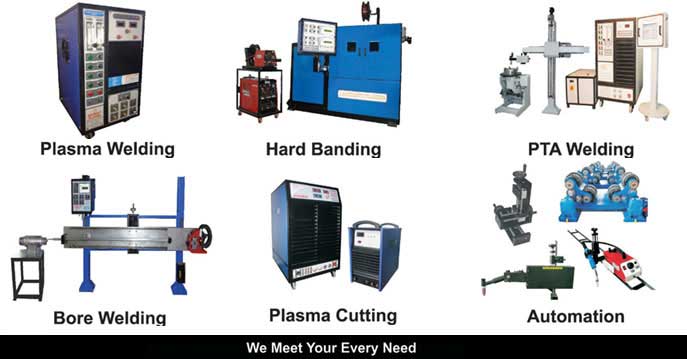



 Increase Productivity and Capacity


