| |
| ESSENTIALS FOR PROPER WELDING PROCEDURES |
| Welding Data >> ESSENTIALS FOR PROPER WELDING PROCEDURES |
|
ESSENTIALS FOR PROPER WELDING PROCEDURES
- Correct electrode size
- Correct current
- Correct arc length or voltage
- Correct travel speed
- Correct electrode angle
Besides the steady sizzling sound that a correct arc produces the shape of the molten pool and the movement of the metal at the rear of the pool serve as a guide in checking weld quality. In a correctly made deposit the ripples produced on the bead will be uniform and the bead will be smooth no overlaps or undercuts.
- CORRECT ELECTRODE SIZE
The correct choice of electrode size involves consideration of a variety of factors, such as the type, position, preparation of the joint, the ability of the electrode to carry high current values without injury to the weld metal or loss of deposition efficiency, the mass of work metal and its ability to maintain its original properties after welding, the characteristics of the assembly with reference to effect stresses set up by heat application, the practicability to heat treatment before and / or after welding, the specific requirement before and / or after welding, the specific requirements as to welding quality and cost of achieving the desired results.
- CORRECT CURRENT
If current on equipment is too high or too low, you are certain to be disappointed in your weld. If too high, the electrode melts too fast and your molten pool is large and irregular, if too low, there is nor enough heat to melt the base metal and your molten pool will be small, will pile up, look irregular.
- CORRECT ARC LENGTH
If the arc is too long or voltage too high the metal melts off the electrode is large globules which wobble from side to side as the arc wavers, giving a wide, spattered and irregular bead-with poor fusion between original metal and deposited metal.
If the arc is too short, or voltage too low, there is not enough heat to melt the base metal properly and the electrode quite often sticks to the work, giving a high, uneven bead, having irregular ripples with poor fusion.
- CORRECTTRAVEL SPEED
When your speed is too fast your pool does not last long enough, impurities an gas locked in. The bead in narrow and ripples pointed. When speed is too slow the metal piles up, the bead is high and wide with a rather straight ripple.
- CORRECT ELECTRODE ANGLE
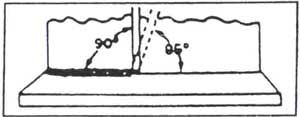
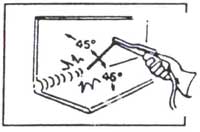
The electrode angle is of particular importance in fillet welding and deep groove welding. Generally speaking, when making a fillet weld, the electrode should be held so that ir bisects the angle between the plates (as shown at right) and is perpendicular to the line of weld, if under cut occurs in the verticle member, lower the angle of the arc and direct the arc toward the vertical member.
 |
|
|

|

















 Increase Productivity and Capacity


